


What it is
The Ayliffe IPC Career Development Fellowship Award provides clinicians working in infection prevention and control (IPC), with the opportunity to take a one-year paid leave of absence in order to further their area of specialty by expanding their knowledge base and disseminating that knowledge to the wider scientific and medical community.
Who can apply
Applications are welcome from Specialty Registrars, Infection Control Nurses and those on a Higher Specialist Scientist Training (HSST) programme
Areas of special interest
The applicant can use their Fellowship year in an innovative and novel way in order to pursue their own specialist focus within IPC. Applicants could consider working within a specialist service, developing expertise, undertaking a significant audit project, developing and implementing a guideline or performing a well defined piece of research.
The Fellowship particulars
The maximum size of the award is £80,000. This consists of up to £72,000 for salary, £3,000 to cover training requirements and £5,000 for research and audit tasks. The duration is the equivalent to 1 year full time.
The fellowship must be based in the UK or Ireland.
Expression of interest
If you would like to express your interest in applying for the fellowship, please complete the expression of interest form.
If you meet the criteria of the fellowship, you will then be invited to complete a full application.
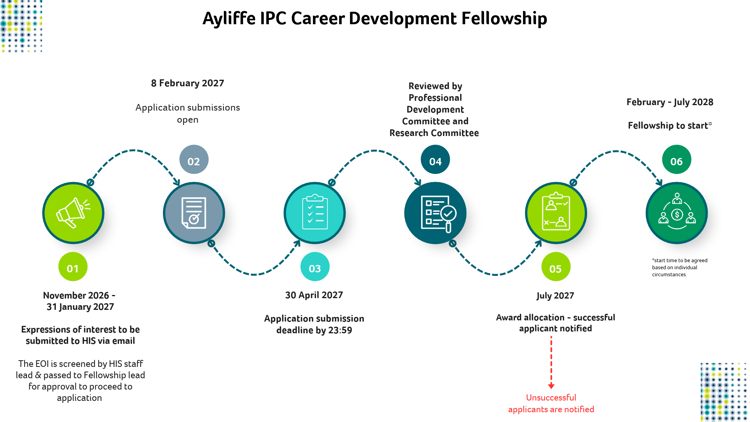
Timescales / deadlines |
|
November 2026 - 31 January 2027 | Expression of interest submitted |
8 February 2027 | Application submissions open |
30 April 2027 | Application deadline |
July 2027 | Award allocation |
February - August 2028* | Fellowship to start *start time to be agreed based on individual circumstances. |
The Ayliffe IPC Career Development Fellowship is open to medically qualified candidates, those on a Higher Specialist Scientist training programme and applicants with nursing qualifications and further training in IPC. Applicants are required to be HIS members.
Applicants who are medically qualified or in Higher Specialist Scientist Training (HSST) must demonstrate:
Registration on a training programme leading to a higher qualification in medical microbiology or virology
Successful completion of the the FRCPath part one examination or equivalent
Satisfactory training progress (e.g. ARCP progression) and be able to demonstrate an interest in IPC
Applicants with a nursing qualification must demonstrate:
Registration to the Nursing and Midwifery Council (NMC)
A post-graduate diploma in IPC or public health
evidence of working as an IPC specialist for a minimum of 2 years
The applicant must be able to take a one year leave of absence (or FTE) from their current post and receive an honorary contract at the Institution.
The applicant is required to identify a Supervisor, who will support the application and provide supervision during the fellowship.
Additionally a member of the HIS council must be identified to act as an external mentor, provided that it will be at the discretion of the person so nominated as to whether they will act as a mentor.
The fellowship year is based at the applicant’s chosen host institution (such as hospital trust, academic organisation or The UK Health Security Agency) and an honorary contract with the institution should be drawn up, together with a job description (in agreement with the Society).
Suggestions include, but are not limited to:
Work in a specialist service relevant to infection prevention and control
Development of specialist skills and expertise with the potential to become a regional and/or national resource of expertise
Undertaking a significant audit project with greater than local scope and completing a full audit cycle
Development of a guideline in an area of significant importance and/or need, including pilot implementation
Production of a structured literature review and/or meta-analysis
Gain experience as a part time trainee editor for the JHI
The award should not be used to support a recipient:
During a course for an examined higher qualification, e.g. a Master’s degree
After an appointment to a Consultant Medical or Senior Nursing grade post at band 8/9
Examples of previously funded fellowships can be found here
Universities
We will only pay the direct costs of research at UK and Irish Universities.
The UK higher education funding bodies provide funding for directly allocated and indirect costs associated with charity-funded research.
In England, this funding is called the Charity Research Support Fund. Similar funding is provided by the Scottish Funding Council, Higher Education Funding Council for Wales and the Northern Ireland government. Higher Education Authority block grants support research costs within the Republic of Ireland.
Research costs in the NHS
For research conducted within the NHS, we follow AcoRD principles for non-commercial studies available here.
For non-commercial studies the normal funding arrangements for research, NHS Treatment and NHS Support costs are:
Research costs - are usually met by grant funders through the award of a research grant. However, there are some specific research activities where, in England, the costs will be met by the Department of Health.
NHS treatment costs - met through the normal commissioning process.
NHS support costs - met from the R&D budget by the Health Departments of the United Kingdom.
Salary, research and training costs:
The successful applicant will receive a contribution of up to £72,000 towards their basic un-banded salary. The exact amount of the award will depend on the current salary of the recipient (comprising basic salary, pension and national insurance contributions) and subject to National Pay Awards. This will be paid six monthly via the host institution upon receipt of an invoice. Funding for this fellowship will be paid in arrears by HIS once an invoice is received. This must be administered by the host institution and managed by the Fellow.
There is also be an additional amount of up to £3,000 to cover any training requirements such as courses and/or conference attendance which should be identified in the application (these costs should be claimed as expenses in arrears from HIS).
A further amount of £5,000 is available for research and audit tasks where there is full justification of expenses in the application
HIS does not award Full Economic Costs (FEC), and such costs cannot be claimed for in this section. Please refer to our Terms and Conditions for further information.
An expression of interest form should first be completed and if successful the applicant will then be invited to complete a full application.
Full application documents will be made available in due course.
Your full application must be reviewed and approved by your host organisation. The application and terms and conditions require signatures from an authorised authority within your institution who undertakes financial management of award, in addition to a Director of Research, Dean of Medicine or equivalent.
Applications must be sent to grants@his.org.uk by 23:59 on the application deadline.
The following items must be included in your application:
Letters of recommendation and support from supervisor at the host institution
Abridged CVs for applicant and supervisor (maximum 2x A4 pages)
A job plan and Gantt chart
Letters of collaboration (if appropriate)
Ethics committee approval and Risk Assessments (if appropriate)
And a signed copy of The HIS Terms and Conditions form (before making an application, applicants are advised to read all Terms and Conditions (click to follow link)
The application should include: aims for the Fellowship year and how the award will benefit the applicants career; training requirements and expected costs.
Application forms, terms and conditions and a C.V. template are available below.
Next steps:
Applications will be triaged for completeness, eligibility and fit to the HIS remit
Applications will be sent to a review panel comprising of members from the Professional Development Committee and Research Committee for peer review, who will meet to discuss the applications and perform short-listing
Applicants will be notified of their progress at this stage
After reviewing the review panel will make a recommendation to the HIS Council regarding the proposal to fund
Applicants may be invited for interview
All remaining applicants will be notified of the outcome
The following Conditions of Funding are absolute and apply in all cases unless otherwise stated:
Financial management and administration of the fellowship
Fellows are expected to manage the budget of their research and training expenses, with oversight from their Research Support Office (or equivalent).
Reporting on project outcomes
Successful applicants are required to report on project outcomes (including publications and follow-on funding). Failure to report the outcomes of your project may result in your department being ineligible to receive HIS funding in the future.
In line with the Society’s terms and conditions, publications resulting from the research must be submitted to the Journal of Hospital infection for first refusal. Award holders will be required to acknowledge HIS funding in oral and poster presentations, and may be asked to present at a HIS meeting or conference.
Research Integrity
Projects are supported on the understanding that all applicants are familiar with the MRC’s policies and guidance on research ethics and research integrity and that the PI has taken ethical considerations into account in the project design, and has or will receive relevant formal ethical review and sign-off by the relevant research ethics committee and governance committees (and any relevant external committees), prior to the commencement of the research. The responsibility for identifying and responding to ethical considerations, referring them for review, and securing approval before the research commences lies with the PI: failure to do so can constitute misconduct.
Extensions
Projects should be completed within 36 months of the grant start date. Grant holders may apply for a no cost extension in line with the Society’s terms and conditions.